


Heard the triumphant shout of “SCOPA!” from across the room and felt left out? That sound is the signature of Italy’s most beloved card game—a noisy, fast-paced game of strategy that looks more complicated than it is. This guide is your ticket in. In less than 10 minutes, you’ll know everything you need to play your first round and understand exactly what all the shouting is about. To find more, check on Login ABILAWA99
To start, you need the right deck. You don’t need special traditional Neapolitan playing cards to get started. Just grab a standard 52-card deck and remove all the 8s, 9s, and 10s. Congratulations, you’re now holding a 40-card Scopa deck, ready for your first game. This simple adaptation is the key to learning how to play scopa anywhere.
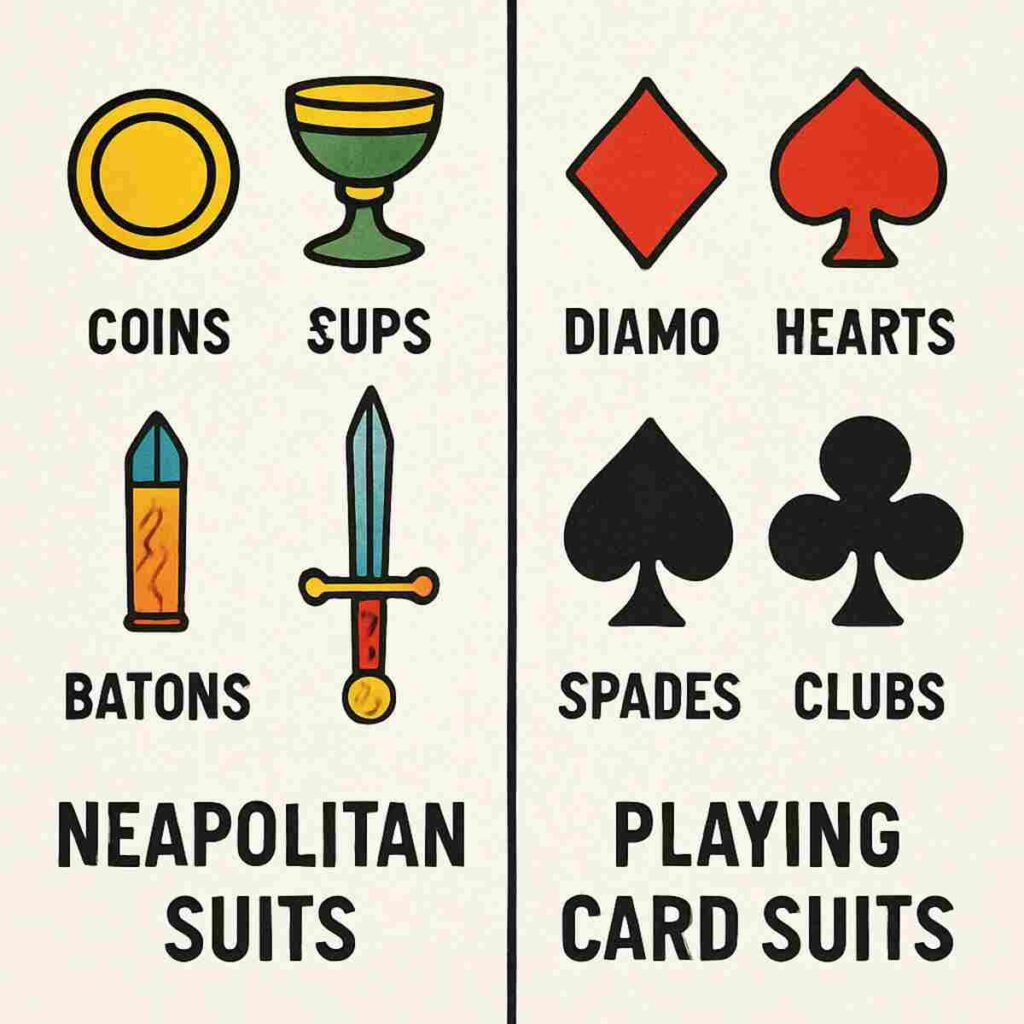
With your deck ready, it’s time to understand the suits. An Italian deck has four: Coins (Denari), Cups (Coppe), Swords (Spade), and Batons (Bastoni). Think of them as the direct ancestors of the deck you know. As you can see, Coins correspond to Diamonds, Cups to Hearts, Swords to Spades, and Batons to Clubs.
Finally, understanding scopa card values and points for capturing is crucial. Unlike many card games, face cards are not worth ten. For capturing purposes, cards are ranked only by their number, with the Ace being the lowest. When you’re trying to capture cards, their hierarchy is:
- King (highest)
- Queen
- Jack
- 7
- 6
- 5
- 4
- 3
- 2
- Ace (lowest)
How to Deal Scopa Cards for a Perfect Start
Getting a round of Scopa started is simple. The chosen dealer shuffles the 40-card deck and deals three cards, face-down, to each player, one at a time, starting with the person to their right. This three-card hand is what you’ll use to play the first part of the round.
After everyone has their hand, the dealer places the next four cards from the top of the deck face-up in the center of the table. This pool of cards is the “table,” and these are the cards everyone will be trying to capture. If the initial table cards include three or four Kings, the deal is considered invalid; just shuffle and deal again.
With cards in hand and on the table, you’re ready to play. The person to the right of the dealer always takes the first turn. After all the cards have been played and scored, the role of dealer simply passes to the next player on the right for the following round.
Your Turn: The Two Ways to Capture Cards
On your turn, you will play one card from your hand face-up onto the table. The goal is to use that card to capture one or more of the face-up cards already there. Any cards you capture are placed face-down in a pile beside you; this is your personal score pile for the end of the round.
The heart of the game is mastering two simple ways to capture cards:
- Matching: This is the most direct capture. You play a card that matches the rank of a single card on the table. For example, if there is a King on the table, you can play your King to capture it. You take both cards and add them to your score pile.
- Summing: This is where the game gets interesting. You play a card from your hand that equals the sum of two or more cards on the table. For example, if the table has a 2 and a 5, you can play a 7 from your hand to capture both of them.
The single most important rule, and one of the most common Scopa mistakes to avoid, is that if you have the option to make a “matching” capture, you must take it. For instance, if the table has a 7, a 4, and a 3, and you play a 7 from your hand, you are required to capture the other 7. You are not allowed to capture the 4 and the 3 instead. The match always takes priority.
But what if you can’t make a capture at all? If none of your cards can either match or sum to the cards on the table, you must still play a card. This is called trailing a card. You simply choose one card from your hand and add it face-up to the center, leaving more options for the next players. Your turn is then over. This simple move sets the stage for one of the game’s best moments: the Scopa.
What is a ‘Scopa’? How to Score the Game’s Most Satisfying Point
The act of leaving a card on the table sets the stage for the game’s most satisfying moment. A Scopa (pronounced SKOH-pah, Italian for “sweep”) is exactly what it sounds like: a play that sweeps the table clean. It happens when your capture, whether by matching or summing, takes every single card from the center, leaving nothing behind for the next player. It’s a powerful move and a huge part of playing Scopa well.
Every Scopa you earn is worth a valuable point when scores are tallied at the end of the round. To remember them, the traditional method is simple: when you make a Scopa, take one of the cards you just won, turn it face-up, and place it in your score pile. This single face-up card serves as a visual trophy, reminding everyone you’ve scored a sweep.
Executing a perfectly timed sweep is one of the best feelings in the game, turning a simple capture into a minor victory. This back-and-forth continues until all players have played the three cards from their hand. So, what happens when your hand is finally empty?
What to Do When Your Hand is Empty
An empty hand doesn’t mean the round is over; it’s just a pause for a reload. Once every player has used their three cards, the dealer simply deals three new cards to each person from the remaining deck. Play then continues with the person whose turn it is, picking up right where you left off. This cycle of dealing and playing three cards at a time continues until the deck is completely gone.
Eventually, the deck will run out and you’ll play the final hand of the round. It’s very common for a few cards to be left on the table with no one able to capture them on their last turn. According to Scopa rules, these leftover cards are awarded to the player who made the very last successful capture of the entire round, no matter how many turns ago it was.
This is a key detail and a common mistake to avoid: collecting the final cards this way does not count as a Scopa. While it can add a lot of cards to your pile, it doesn’t earn you the extra point for a sweep. Once those last cards are collected, the round is officially over. Now, with all the cards accounted for, it’s finally time to count up the points.
How Scopa Scoring Works: The Four Easiest Points to Count
The round is over and a pile of captured cards sits in front of you. This is the payoff. While Scopa’s scoring can seem complex, most of it is just simple counting. Think of it as a four-item checklist you run through at the end of every round. For each category you win, you get one point.
Grab your pile of captured cards and compare it with your opponent’s to see who earns a point for the following:
- Le Carte (The Cards): First, simply count all the cards you captured. There are 40 cards in total, so if you have 21 or more, you get one point for having the majority.
- I Denari (The Coins): Next, sift through your pile and pull out only the cards from the Coins suit (or Diamonds, if you’re using a standard deck). The player who captured the most cards of this suit—even if it’s just 6 out of 10—gets a point.
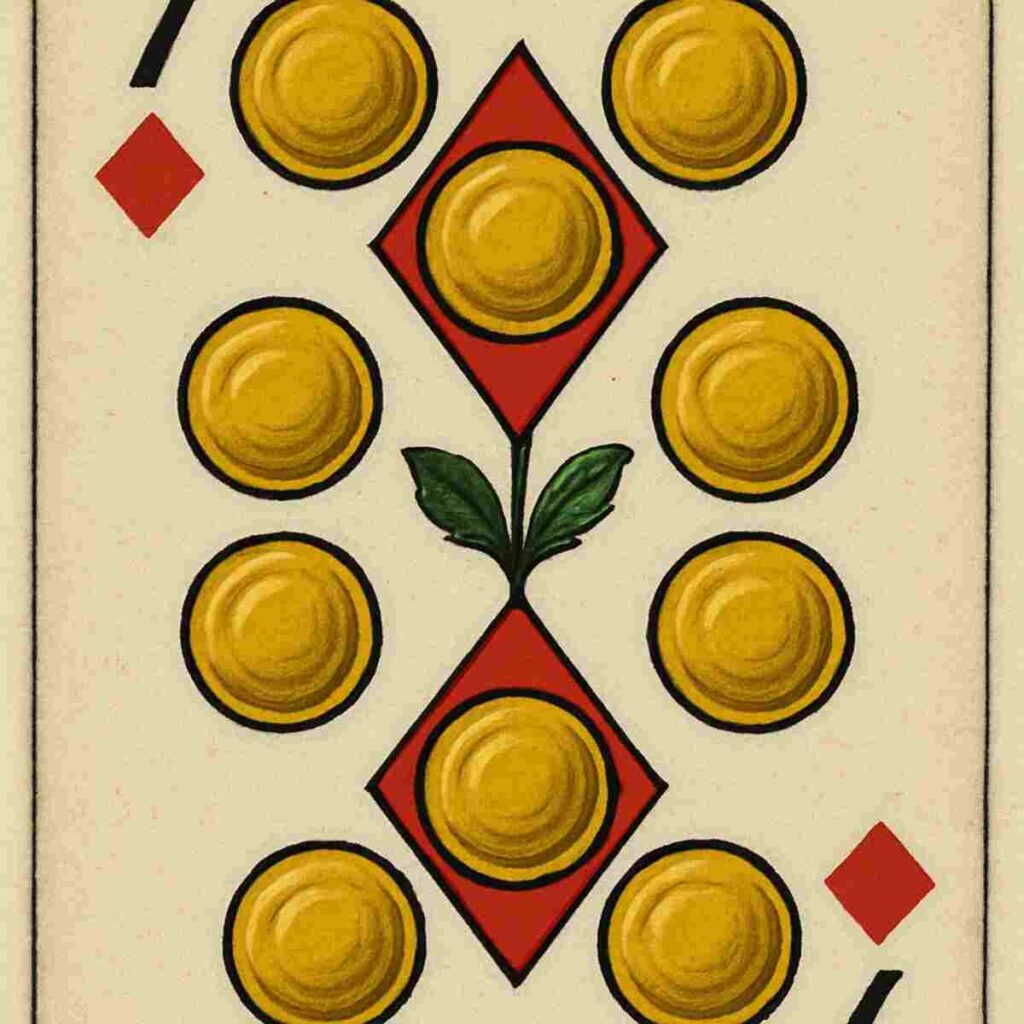
- Il Settebello (The Beautiful Seven): This famous point isn’t about having the most of something, but about capturing one specific card. Look through your Coins for the 7. If this single card is in your pile, you earn a point for capturing the Settebello (pronounced set-teh-BELL-oh).
- Le Scope (The Sweeps): Finally, count up the points for any sweeps you made during play. You get one point for every Scopa you achieved.
After running through this checklist, you might find that you won the point for Carte, while your opponent won Denari and also grabbed the Settebello. In that case, you’d get one point and they’d get two. The points are distributed based on who won each contest.
In many friendly games, these points are all you need to declare a winner for the round. However, for those who want to play like a true regular at a Neapolitan café, there is one more “expert” point that can break ties and add a new layer of strategy.
Unlocking an ‘Expert’ Point: A Simple Guide to the Primiera
The Primiera (pronounced pree-mee-AIR-ah) is often the last point new players learn, but it adds a fascinating layer to the game. Don’t be intimidated by the Italian name; the concept is simple. It’s a point awarded to the player who has the “best” set of cards, determined by creating the highest-scoring combination using one card from each of the four suits. If a player hasn’t captured at least one card from every suit, they can’t compete for this point.
To figure out who has the best set, you need to know which cards are most powerful for the Primiera. For this specific point, the card ranking is unusual: Sevens are the absolute best, followed by Sixes. After that, the ranking goes down from the Ace. For your first few games, you can often eyeball the winner without doing any math: just lay out your best card from each suit and compare. The player with more Sevens and Sixes in their set usually wins the point.
For those who want the official calculation, here’s how the points are assigned to each card in your four-card set:
- Seven = 21 points
- Six = 18 points
- Ace = 16 points
- Five = 15 points
- Four = 14 points
- Three = 13 points
- Two = 12 points
- Face Cards (King, Queen, Jack) = 10 points
Each player finds their best card from each suit and adds up the point values for their four cards. The player with the highest total score wins the Primiera and gets one point for the round.
How to Win the Game: From a Single Round to Final Victory
Once you can tally up the points from a single hand, the big picture comes into focus. A game of Scopa isn’t won in a single round; it’s a race. At the end of each round, players add any points they earned to a running total. Keeping track with a simple pen and paper is the easiest way to see who is pulling ahead.
So, what’s the finish line? The classic game of Scopa is played until one player or team reaches 11 points. The first to hit or exceed this magic number at the conclusion of a round is declared the winner. While 11 is the traditional target, many families play to 16 or 21 for a longer game—feel free to agree on a target score before you begin.
If no one has reached the target score after the points are counted, the game simply continues. The role of dealer passes to the next player, the cards are all shuffled together, and a new round begins. Your previous points carry over, giving you a head start on your way to victory.
Avoid These 3 Common Beginner Mistakes in Scopa
With the goal of 11 points in your sights, you’re ready to play with purpose. But a few quirky Scopa rules can trip up even the most enthusiastic newcomer. Understanding these common pitfalls ahead of time will give you a major advantage.
The single most important rule to remember is that a matching capture is mandatory. If you have a card in your hand that matches the rank of a card on the table, you must play it to make that one-for-one capture. For example, if a 5 is on the table and you hold a 5, you have to capture it. You are not allowed to use your 5 to instead capture a 2 and a 3.
Another easy pitfall involves simple arithmetic. When making a summing capture, the numbers must add up exactly. If a 2 and a 4 are on the table, only a 6 can capture them. You can’t play a 7 and get “change back,” so to speak. Confirm your math is precise before you play, as there are no take-backs!
Finally, don’t get so focused on capturing any card that you ignore the right cards. Letting your opponent easily grab the Settebello (the 7 of Coins) or a pile of other Coin cards (Denari) is one of the quickest ways to lose a round. A basic strategy starts with recognizing these valuable cards and prioritizing them. Steering clear of these common mistakes will make you a much tougher opponent.
Playing with Friends: How to Play Scopa with 3 or More Players
Scopa shines as a two-player duel, but what happens when another friend wants in? You might be wondering, can you play Scopa with 3 players? Absolutely. The game adapts easily with one tiny adjustment: before you start, simply remove one card from the deck to ensure the cards deal out evenly. Traditionally, the 4 of Coins is taken out, leaving you with 39 cards. From there, you deal three cards to each of the three players and proceed exactly as you would in a standard game, with each person playing for themselves.
For an even number of players, Scopa transforms into a lively four-player partnership game. You play in two teams of two, with partners sitting directly across from each other. Gameplay remains identical, but the strategy deepens as you try to set up your partner for a good capture. At the end of the round, you and your partner combine all the cards you’ve won into a single pile to score your points together.
Once you’re comfortable, you might want to try a popular variant. The most common is the Scopa d’Assi variation, or “Ace Sweep.” In this version, if you play an Ace and there is no Ace on the table to match, you capture all the cards currently in the center. This simple change makes Aces the most powerful cards in the game and adds a thrilling, high-risk element to every hand.
From Beginner to Winner: 3 Simple Strategies for Your First Game
Knowing the rules is one thing; knowing how to win is another. The best Scopa strategy isn’t about complicated math, but about developing smart habits that prevent you from handing points to your opponent. These simple tips will make a huge difference.
One of the most common beginner mistakes is accidentally setting up an opponent for a big score. Be very careful what you play when you can’t make a capture. If you’re forced to discard, avoid playing a valuable card (like a 7 or King). Leaving a lone 8 gives your opponent a chance to capture it or use it in a combination to sweep multiple cards. Think of your discards as potential gifts—try to make them as small as possible.
While you don’t need to count every card, pay attention to who is winning two key point battles: Coins (Denari) and the Settebello. By noticing which player’s pile is growing with gold-colored cards, you’ll know who your rival is for the Denari point. Likewise, once the precious 7 of Coins is captured, make a mental note of who took it. This lets you know where to focus your efforts.
So, what should you do when you can’t make a capture and need to play safely? This is where one of the most useful Scopa tips comes in: play a low-numbered card. Discarding a 1, 2, or 3 is almost always your safest move. These cards offer your opponent the fewest possible capture combinations, protecting you from giving up a valuable sweep. Keeping these strategies in mind will elevate your game from just knowing the rules to playing to win.
Your Scopa Quick-Start Checklist: You’re Ready to Play!
Just a few minutes ago, the energetic smack of cards and shouts of “Scopa!” might have seemed like an insider’s secret. Now, you have transformed from a curious observer into a capable player, ready to join one of the most beloved Italian card games.
To get your first game started, just remember these essential rules:
- Prepare Deck: Use a 40-card Italian deck (or a modified standard deck).
- Deal Cards: Three to each player, four face-up to the table.
- Play & Capture: Use one card from your hand to match or sum up cards on the table.
- Score Points: After the round, count points for Scope, Carte, Denari, Settebello, and Primiera.
- First to 11 Wins!
You now have everything you need to know how to play Scopa. The rules are no longer abstract ideas; they are a clear path to your first round. So grab a deck and a friend. Don’t worry about perfection—the real goal is to share in the fun. It’s time to deal the cards and get ready to shout “Scopa!” with confidence.